United States Coast Guard
The TrenchThe United States Coast Guard appears through the Chinook and its crew off Cape Disappointment, where a routine training exercise becomes a real rescue emergency after a Megalodon attacks. The sequence establishes the Coast Guard’s practical role in the story—training people to work in dangerous waters and responding when danger overwhelms that preparation—while showing how quickly an exercise can become a crisis beyond the crew’s control.
The Chinook and its crew
At 6:45 a.m., under a gray morning sky, the Coast Guard rescue vessel Chinook is heading into heavy seas with a four-man crew. Lieutenant Eric “Big Daddy” Wisdom oversees cadets Geary and Richardson, trainees in the Coast Guard’s heavy-surf and weather rescue course. The course is taught exclusively in the waters off Cape Disappointment, a location selected in the narrative for the severity of its conditions rather than for any sheltered practice environment.
The cadets wear protective helmets and heavy-weather gear and are harnessed to a steel rail behind the open pilothouse. Their first exposure to what Wisdom calls challenging waves is deliberately demanding: he asks pilot Deacon to take the vessel farther out so they can learn humility before meeting Oscar, a rescue dummy. The crew’s training is therefore both instructional and physical. The cadets must hold on in the open, exposed to waves that strike the vessel with enough force to lift its bow and drop a mass of water across the crew.
A training ground shaped by the sea
The setting gives the exercise its particular risk. Storm centers in the Pacific Ocean send waves across thousands of miles of open water; some travel for a week or longer before reaching the Northwest coast. Near Cape Disappointment, the swells become walls of churning water. The account notes that more than two thousand vessels have sunk off the cape since the early 1800s, framing the training area as a place where experience and preparation matter but cannot remove the danger.
During the exercise, Deacon reports winds of thirty-one knots and waves moving at thirty-three miles per hour, conditions estimated at about a seven on the Beaufort scale. Wisdom treats the conditions as suitable for the lesson and directs the pilot farther out. That decision places the crew in the path of the danger that follows. The narrative’s contrast is not between competence and carelessness alone: the crew is conducting an established course in a notoriously hazardous environment, but the threat they encounter is outside the exercise’s expected limits.
From rescue exercise to attack
Oscar provides the first sign that the situation has changed. When Wisdom inspects the dummy, its upper torso has been bitten away. The damage recalls a seventy-two-foot great white shark he had seen feeding in the Tanaka Lagoon four months earlier, and fear replaces his earlier confidence. He orders Deacon to take the Chinook back in.
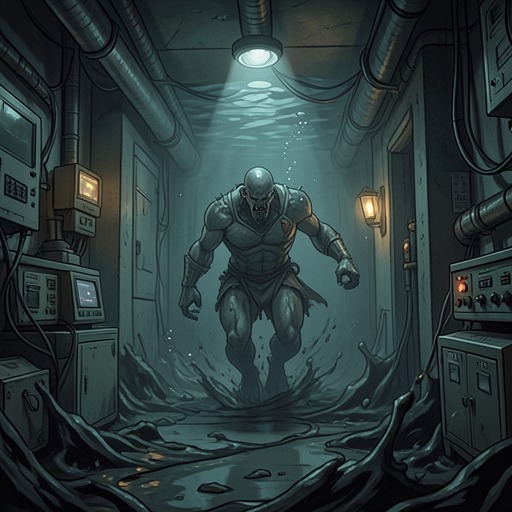
Before the vessel can escape, the Megalodon strikes its hull. The impact cracks four supporting ribs and sends the Chinook sideways. The attack converts the crew’s training into a fight to survive: the rescue vessel itself is now damaged, and the crew is caught in the same dangerous water in which it had been teaching the cadets to operate. The cadet Geary sees terror in Wisdom’s eyes just before the lieutenant loses consciousness, a reversal that makes the instructor, as well as his trainees, dependent on rescue.
Rescue and aftermath
Jonas Taylor and James “Mac” Mackreides encounter the overturned hull while searching from a helicopter. Jonas sees no survivors, and Mac says he will radio the Coast Guard. A powerful swell then carries the wreck out of sight. When they locate people in the water, Mac maneuvers the helicopter close enough for Jonas to reach the unconscious lieutenant. Jonas hauls Wisdom aboard by his life vest while another person pushes from the water; a cadet grabs Jonas’s wrist and the landing struts as the creature rises beneath him. Mac pulls the helicopter upward just as the shark opens its jaws below the dangling cadet.
The rescue leaves two Coast Guard survivors. Later, Jonas is told that the man who had been in shock should recover and that the cadet had broken his leg in the fall. James “Mac” Mackreides had flown both to a local hospital a few hours earlier. The account thus distinguishes the immediate danger of the attack from the injuries and shock that remain after extraction; reaching safety does not make the encounter consequence-free.
Narrative significance
The Chinook episode gives the Coast Guard a sharply defined presence without portraying the institution as able to control the sea. Its people train in severe conditions, assess the weather, and attempt to bring the vessel in when the evidence of danger becomes unmistakable. Yet the attack outstrips that preparation, and survival depends on an outside aerial rescue by Jonas Taylor and James “Mac” Mackreides. The sequence also ties the Coast Guard’s practical work to the story’s larger uncertainty: the sea is not merely a difficult environment for trained crews, but a habitat for a threat their ordinary expectations cannot contain.